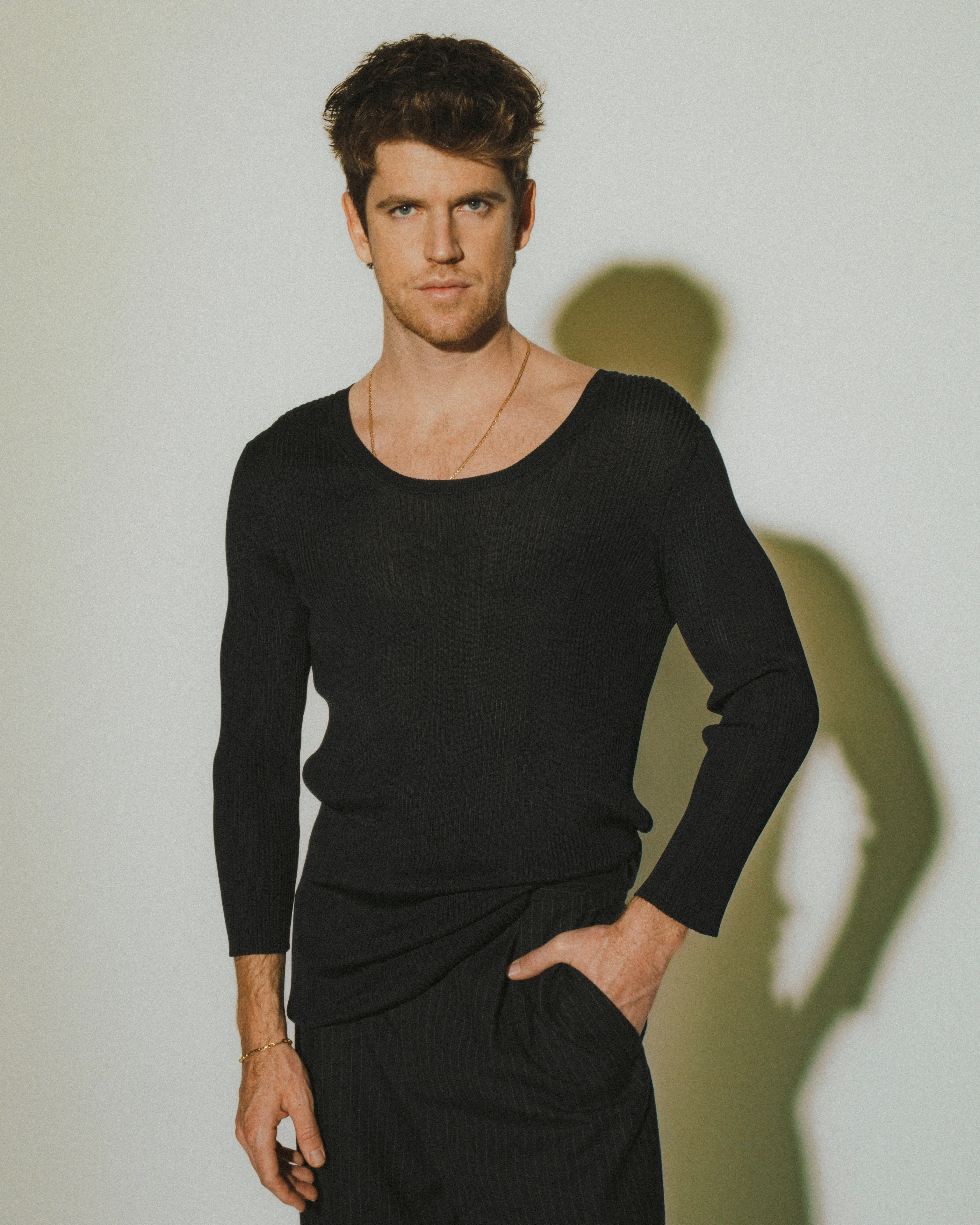
Photo by Una Burnand Miguel Bernardeau spent a week convinced he’d lost the biggest role of his career. The 29-year-old Spanish actor—best known stateside as Guzmán, the swaggering rich kid on Netflix’s cult teen drama Élite —had just auditioned for La Bola Negra , the queer Civil War epic from Javier Calvo and Javier Ambrossi, the directing duo known as Los Javis. The film has since won Best Director at the Cannes Film Festival and the People’s Choice Award at Toronto, sold to Netflix in a bidding war, become Spain’s Oscar submission, and been rumored as a possible challenger to Christopher Nolan’s The Odyssey for Best Picture. But back then, Bernardeau walked out of his audition certain he’d blown it. “I spent the next week thinking, fuck, I just lost the opportunity of a lifetime,” he tells W .
Then came a callback at the offices of El Deseo, Pedro Almodóvar’s production company. In the room was Álvaro Lafuente, the (also 29-year-old) singer known as Guitarricadelafuente. The two had never met, but when they read a couple of scenes together, the chemistry was instant. “When I lifted my eyes, everybody was very emotional,” Bernardeau says. Only then did Los Javis tell Bernardeau they had written the character he was reading just for him. “That says a lot about how much we suffer pointlessly sometimes,” he says with a wry smile.
Months before, at the Goyas (Spain’s version of the Oscars), Calvo pulled Bernardeau aside and told him to read Alberto Conejero’s play La piedra oscura . Its subject is Rafael Rodríguez Rapún, the last known lover of Federico García Lorca, the poet and playwright killed by Nationalist forces a month into the Spanish Civil War in 1936. “I read it, and I loved it. I immediately understood they wanted me to play Rafael,” Bernardeau says.
Miguel Bernardeau as Rafael and Guitarricadelafuente as Sebastian in La Bola Negra
La Bola Negra —Los Javis’ first feature since their 2017 debut, La llamada —is a sweeping, nearly three-hour epic co-written with Conejero, spanning eras from Granada in 1932 to a Francoist military camp in Cantabria in 1937 to Madrid in 2017, with a cast that includes Lafuente, Glenn Close, and Penélope Cruz, who turns up for a brief but memorable sequence that’s already earning her supporting-actress buzz. (Netflix is also betting big on the film, giving it the longest theatrical window in the company’s history: 47 days in theaters, before it hits streaming on December 2.)
For Bernardeau, it’s the biggest swing of an acting career that he says began without much of a plan. Born in Valencia, Bernardeau grew up around the business: his mother is Ana Duato, the star of Cuéntame cómo pasó , the long-running family saga set in Franco-era Spain that his father, Miguel Ángel Bernardeau, produced; his first screen credit was a bit part on the show in 2016, as a Guardia Civil officer. He left Spain to study acting at Santa Monica College and the American Academy of Dramatic Arts in Los Angeles, and his breakthrough came in 2018 with Élite . Since then, he’s been in Netflix’s 1899 , played the title role for Amazon’s Zorro , and starred in Querer , a critically successful miniseries in Spain. “At the beginning of your career, you just want to work,” he says. “I would be lying to you if I told you that I had a plan.” Now, he says, “I’m in a position where I can start to choose a bit more.”
This role chose him. As Rafael, Bernardeau anchors La Bola Negra ’s 1937 storyline. When we meet him, he’s a wounded Republican soldier, captured by Nationalist forces and held in a military hospital on suspicion of carrying classified information. His guard is Sebastián (Lafuente), a young musician who survived an attack on his village and was conscripted into the fascist army. Sebastián is a purely fictional character from Conejero’s play, but Rafael was a real person, and the broad strokes of his storyline are true to history. Born in 1912, Rafael was a mining engineer, Atlético Madrid footballer, and actor. He became the secretary of La Barraca, the touring theater company Lorca led, where he and the playwright fell in love.
After Lorca was executed, Rafael enlisted and became a Republican lieutenant, dying in Cantabria a year to the day after the poet. The film imagines the parts of history we can’t know, including a last conversation between Rafael and Lorca (Alberto Cortés), shown in black-and-white flashback.
To Bernardeau, Rafael’s late turn toward the arts points to “something he couldn’t name inside of himself,” the inner conflict of a man who “rediscovered his own masculinity at a time where that didn’t even have a name, at a time where people would look bad at you if two men would walk for too long together on the street.”
“You could not define Rafael in a couple of lines if you really wanted to speak about him,” he adds. “I love that.”
On screen, Rafael is a man of few words. Bedridden for much of the film, he relies on his facial expressions and body language to show what he’s feeling. Much of that plays out opposite Lafuente, and Bernardeau is quick to say his costar’s greenness—the film marks his acting debut—never showed. “I didn’t feel that I was working with somebody that had nothing going on because he didn’t know how to act [yet],” he says. “Not at all.”
La Bola Negra adds to Spain’s long tradition of LGBTQ+ cinema that explores the country’s relationship to queerness, masculinity, and the arts through the decades. Bernardeau, who doesn’t identify as queer, plays one of its three gay leads, joined by the openly gay Lafuente and Carlos González (who plays Sebastián’s descendant in the 2017 scenes, which audiences are transported to at least once by the ping of a Grindr notification).
Julio Torres and Carlos González in La Bola Negra
But “the main topic of La Bola Negra is not sexuality,” Bernardeau says. “We don’t need to make a gay movie. It’s just a movie in which the characters are gay. And that is a big thing for us in Spain and in the world.”
The film also speaks to a moment when Spain is still coming to terms with the Civil War and the nearly 40 years of dictatorship that followed, a history Bernardeau says the country has long avoided discussing “because it was so painful.” Preparing for the role, he studied the war and the Franco regime’s persecution of LGBTQ+ people, along with anyone else who stepped out of line. “I’m very grateful that I’m an actor because I get to study that,” he says. “I would’ve never done that if I wasn’t an actor.”
The research led him back to his own family. His grandmother made churros in a small town in Albacete, he says, and he’d fall asleep with his head on her lap as she told him stories about how her brothers left for the war and only one came back. She has since died, but making the film brought him closer to her, and to his own history. “When I was doing the movie, I felt I was connecting with her in that way,” he says.
He then brings up a line from the film’s 2017 storyline, in which Alberto, a historian, is needled by his boyfriend, played by Julio Torres. “Don’t you think it’s interesting that you are a historian and the only story you haven’t started is your own?” he asks. “As actors, it’s the same thing,” Bernardeau says. “We’re very interested in everybody’s story, but what about yours?” Looking into his own, he adds, “You’re not judging; you just want to know where you’ve come from.”
After the festival run, La Bola Negra must now find its audience in the U.S. “I wonder how the American audience is going to react to it,” Bernardeau says. “I’m very curious.” Whatever happens, he says Los Javis’ faith in him “changed my life forever, not only because of the success of the movie, but because this process has been very cathartic and has awakened a lot of things in me.”
Source: ShowBiz



0 Comments