
Capt. Eugene Cernan bounded across the surface of the moon for the last time, clasped the ladder of Apollo 17 and paused.
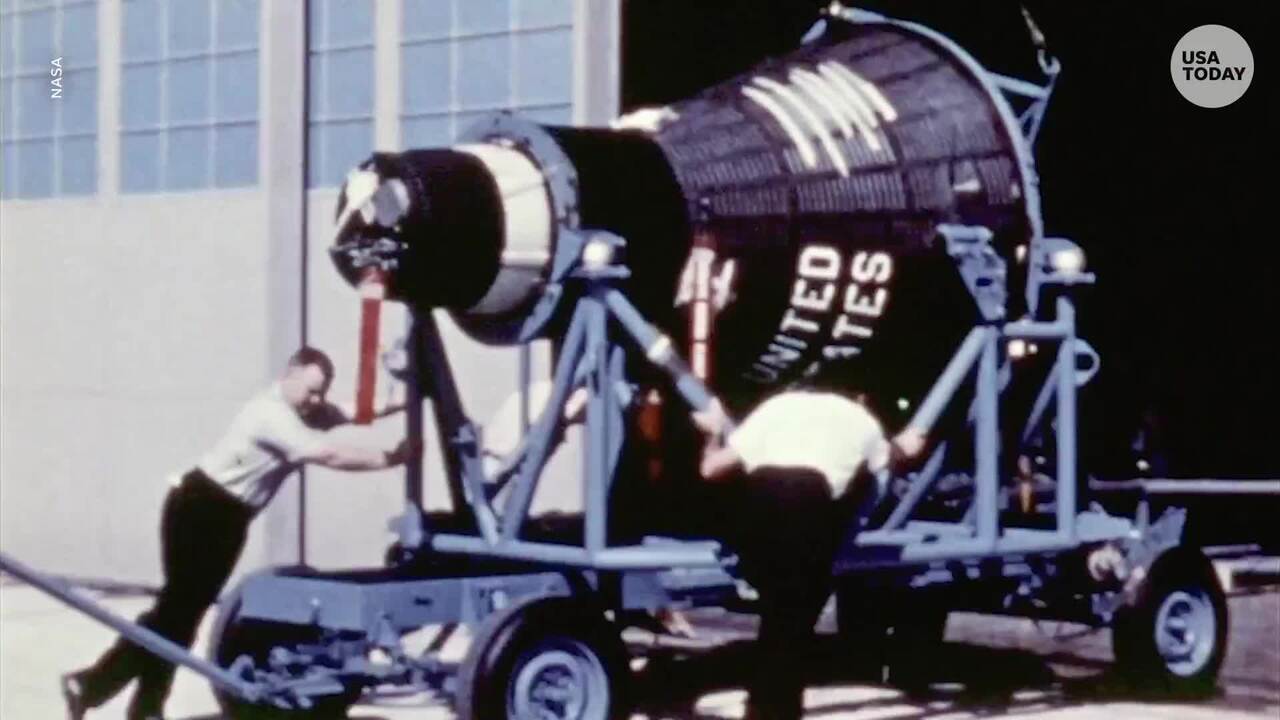
"I believe history will record that America's challenge of today has forged man's destiny of tomorrow," he said in part, his comments recorded by NASA. "And as we leave the moon at Taurus-Littrow, we leave as we came, and God willing as we shall return, with peace and hope for all mankind."

It was 1972, and no one has set foot on the moon since.
Five decades on, NASA is planning to return in the next few years with its Artemis missions – but few Americans are even paying attention.
America got to the moon and planted a flag in 1969. So, as it plans a return and perhaps someday a trip to Mars, the question for many people is: Why? Is peace and "hope for mankind" still the goal? And if not, what is?
To mark the 250th anniversary of the United States, USA TODAY dispatched reporters to follow classic American journeys ‒ some happy, some tragic ‒ that helped shape this country.
No journey of American achievement and exceptionalism is more iconic than the Apollo voyages to the moon in the 1960s and 1970s.
In 1961, President John F. Kennedy decided the United States could not let the Soviet Union win the space race, so he devoted millions in taxpayer resources to winning that battle.
Its success inspired a generation to become scientists, doctors and researchers and changed the way Americans think about themselves. It helped define what it means to be American. We got a man to the moon. We were the people who could accomplish anything.
In the decades since, NASA has changed its priorities – from taking earth-bound rivalries into the sky to exploring the farthest reaches of the heavens and now to more pedestrian business interests, like building data centers on the moon's pitted surface.
And it hasn't done a great job of explaining to the average person what its discoveries have meant for them.
Life on Earth has directly benefited from America's space program, said space policy expert Greg Autry, who served as White House liaison to NASA in the first Trump administration.
The space program has led to the invention of heart rate monitoring technology, scratch-resistance lenses, memory foam mattresses, rechargeable batteries, wireless headphones, the Jaws of Life rescue tool, GPS and even banking technology. Our ability to communicate with each other through cell phones and satellite transmissions depends on space-delivered technologies.
"The general public doesn't understand how incredibly important space is to them on a daily basis," Autry said. "Our modern civilization would not continue to operate without our regular investment in space."
A journey that few took but many joined
In May 25, 1961, Kennedy asked Congress to commit the nation to landing a man on the moon before the end of the decade. Just over a year later, he gave his iconic "Moonshot" speech at Rice University in Houston, where he called the goal a test of American spirit and skills and presented space as a new frontier for knowledge, peace and progress for all mankind.

"We choose to go to the moon in this decade and do the other things. Not because they are easy, but because they are hard," Kennedy said.
It was a reach. Soviet cosmonaut Yuri Gagarin had become the first human to voyage into space just a month before, with American astronaut Alan Shepard close on his heels.
"Most people don't remember that when John Kennedy got up as president before a joint session of Congress … NASA had exactly 15 minutes of practical human space flight experience, one suborbital flight. So almost everything that needed to be invented in order to achieve the moon landings still needed to be worked out," said Margaret Weitekamp, curator of the Smithsonian National Air and Space Museum.
Of course, the journey to the moon wasn't just about the scientific thrill. The driving force was America's rivalry with the Soviet Union.
"The space race is really best understood as a battlefield in the Cold War. In that global conflict … you found these other proxy battlefields to be able to work out the difference between these economic, cultural, political systems," Weitekamp said.
In 1969, eight years after Shepard's flight, Neil Armstrong stepped onto the moon's surface.

It was an all-of-nation effort, with NASA relying on contractors from all 50 states and hundreds of thousands of Americans.
"There was a great dedication of national resources to science education, broadly, but also up to as many as 400,000 people nationwide working on solving different parts of the Apollo program problems," Weitekamp said.
It also took an unheard-of influx of federal resources into the space program to achieve ‒ nearly 4.4% of the nation's gross domestic product went to NASA in the mid-1960s. NASA's budget is now closer to 0.4%.

The Apollo missions captured the imagination of the world and helped define what it is to be American, Weitekamp said.
"It taps into these core ideas of American identity as explorers, as innovators and inventors, and really looking to the future for what's next," she said.
Changing times, changing visions
By the time Cernan left his last footprints on the moon, things were already changing.
NASA had already canceled the three other scheduled Apollo missions. Public interest in more trips to the moon had faded, support from the president had dropped and Congress had cut the agency's budget.
And the foreign bogeyman was no longer the driver. America showed its willingness to collaborate in space when the United States and the Soviets docked an Apollo and a Soyuz capsule together in 1975.

Since then, space access has become less of a contest, with hundreds of countries working together, said Geoff Notkin, former president of the National Space Society, a space advocacy nonprofit.
"It was competition with the Russians that got us out there at the beginning, but now it's cooperation with other countries and within the United States, cooperation between government agencies and independent space flight companies," he said.

Then, on Jan. 28, 1986, America got a sharp reminder of the dangers of space travel when space shuttle Challenger exploded 73 seconds after launching. Its seven-member crew was killed instantly. Millions of people, including schoolchildren nationwide, watched. Americans' confidence in the space program – and its own ingenuity – was shattered.
A generation would pass before Americans would consider crewed flights to space again. In 2004, President George W. Bush announced that America's vision for space exploration would return to human spaceflight. He also emphasized international collaboration and announced plans to phase out the space shuttle program.
But since Bush, nearly every president has shifted NASA's goals, with budgets often not matching ambitions. President Barack Obama scrapped Bush's moon return aspirations, instead pushing to extend the life of the International Space Station.
NASA has shifted toward commercial partnerships in which the government acts more like a manager than a driver. The agency has tapped billionaire-led private companies like Jeff Bezos' Blue Origin andElon Musk's SpaceX to bring its cargo and crew to space. And private companies are playing a high-profile role in the Artemis moon missions, with NASA increasingly outsourcing space-related services to commercial providers.

"We're switching to this model where NASA says, 'We want to go here and do that. You provide us with a complete solution and we're going to pay you a single price,'" said Autry, the space policy expert.
Advertisement
In recent years, four major space flight corporations have largely focused on NASA contracts for reusable rockets, cargo drops to the International Space Station ,and capitalizing on how to one day make money in low Earth orbit and on the moon.
In other words: crewed space missions increasingly factor in a corporate bottom line.
"We're in a transition phase [with] entrepreneurs trying to find things to do in space that are profit generating. I don't think there's been any golden goose in the past 50 years," said John Logsdon, former director of the Space Policy Institute at George Washington University.
Planning a return to the moon
In 2017, nearly a year after Cernan's death at age 82, PresidentDonald Trumpinstructed NASA to focus on sending American astronauts to the moonfor long-term exploration and establishing a foundation for an eventual mission to Mars.
PresidentJoe Bidencontinued the project, and Trump came into his second term raring to continue it. In his January 2025 inauguration speech, Trump vowed to pursue "manifest destiny into the stars" by planting the American flag on the red planet within a few years.

But, NASA's budget hasn't increased to match the new vision. Congress has boosted it by about a billion dollars each year since Trump's initial announcement, to roughly $25 billion in 2025. At the height of the space race, NASA received the equivalent of about $40 billion a year in today's dollars.
"There's no extra money going into Artemis. There's no cushion," said Mark Marquette, director of the American Space Museum.
Space experts say the lack of financial support matches a lack of public interest. Rocket launches are now routine, but they largely carry satellites. Artemis I, an uncrewed moon orbiter that kicked off the return to human space missions, launched in the middle of the night in November 2022 ‒ a far cry from the live broadcast of the Apollo launches that had millions glued to their televisions.
This year, four astronauts ‒ three Americans and a Canadian ‒ are supposed to slingshot around the moon on Artemis II, though the launch has already been delayed twice.

After Artemis II faced liquid hydrogen leaks and was unable to launch in late February, NASA abruptly announced it was shaking up the Artemis mission plan in an attempt to launch more frequently. The next chance to launch Artemis II is April 1.
Once the slingshot mission of Artemis II is complete, Artemis III will dock with a commercial spacecraft in low Earth orbit rather than landing on the moon in 2028.
Artemis IV will instead be our return to the moon, with a second moon landing also planned for that year. Further Artemis missions slated to build the Gateway space station in the moon's orbit and establish a permanent lunar colony.

Some are trying to stir public interest by casting the Artemis missions as another space race, with China now our competitor.
"The leaders of the space program needed to find a rationale for continued spending $26 billion a year on the government program and Space Race worked once. They go back and say, why not do it again?" said Logsdon, the former Space Policy Institute director.
China's space agency has plans to land on the moon by 2030 near the south pole, where there are believed to be deposits of ice from comets. China is not among the more than 60 countries that have signed the Artemis Accords, a U.S.-led framework for cooperation, civil exploration and peaceful use of the moon, Mars and astronomical objects.
Billionaire private astronaut Jared Isaacman, Trump's new NASA administrator, said during his second Senateconfirmation hearing in Decemberthat "if we fall behind, if we make a mistake, we may never catch up and the consequences could shift the balance of power here on Earth."
Issaacman said failing to return to the moon "calls into question American exceptionalism."
Dava Newman, an aerospace engineer and a former deputy administrator of NASA, disagrees. China and other countries want the prestige of landing on the moon, while the United States wants to use the moon as a stepping stone.
"The U.S. is not in a space race with China," said Newman, who is also a professor at the Massachusetts Institute of Technology.
If the moon is a springboard, Mars is the destination. NASA has plans to reach the red planet in the 2030s.
But it won't be easy.
The "moon is a three-day trip," Newman said. "Mars, you need eight months. Those are very different targets."
Space still influences America
The idea of exploring the final frontier still grips the America psyche. Millions of people flock to the Smithsonian's two air and space museums in Washington and their affiliates at major NASA heritage sites in Texas and Florida each year. Kids still want to grow up to be astronauts, and adults are still mesmerized by space in movies, television and books.
"One of the most potent symbols of American nationalism is pictures of astronauts standing on the moon with the flag," Logsdon said.
Decades of focus on low orbit and deep-space scientific discoveries have colored people's view of what NASA does.
"Launches and reentries are exciting. But raising celery on this orbiting space station is not very exciting," Logsdon said.
Still, "it's hard to imagine NASA firing its astronauts. … They've become part of American culture," he said.
AJuly 2023 Pew Research studyfound that about 7 in 10 Americans say it is essential that the United States continue to be a world leader in space. In that same survey, Americans said NASA's top priorities should be monitoring asteroids that could hit Earth and monitoring Earth's climate system. But only 12% said sending someone to the moon should be a top NASA priority, and just 11% said the same of Mars.


Searching for signs of life on Mars, NASA's robotic missions dig for clues
Most people said they expect space tourism to become a reality, but private spaceflight and new trips to the moon aren't speaking to Americans who grew up in a world where spaceflight has always existed, said Marquette, the American Space Museum director.
Kennedy framed space travel as humankind's greatest adventure. "Back then it was fulfilling a fantasy," Marquette said.
Doing more in space than we've already done won't be easy or cheap – something Americans weaned on moon landing imagery and science fiction don't fully understand, he said. There is no warp drive, no faster-than-light travel, no planetwide organization united behind the single purpose of exploring the stars.
"The reality of it is it's very hard, and it's unforgiving," Marquette said. "You can reboot a video game if you get blown up, you know, but you can't reboot in outer space."
Cernan closed his 1999 autobiography, "The Last Man on the Moon," with a passionate plea for space travel to recapture the American spirit.
"Too many years have passed for me to still be the last man to have left his footprints on the Moon," he wrote. "I believe with all my heart that somewhere out there is a young boy or girl with indomitable will and courage who will lift that dubious distinction from my shoulders and take us back where we belong. Let us give that dream a chance."
Sarah D. Wire, a senior national political correspondent with USA TODAY, covers where people and politics intersect. She can be reached at swire@usatoday.com
This article originally appeared on USA TODAY:The space race's evolution shows how much America has changed
