
WASHINGTON –Former FBI Director Robert Muellerwas considered a hero to many, including the Marines under his command in combat in Vietnam and the FBI agents working for him after the Sept. 11, 2001 terrorist attacks.
And ultimately, in a career-defining move, Mueller became a hero to those working the politically-charged criminal investigation by the Justice Department into associates of then-PresidentDonald Trumpand Russian presidentVladimir Putinover Russian interference in the 2016 election that brought Trump to power.
Mueller made many enemies along the way, especially Trump and his supporters, after refusing to say that the then-President hadn't broken any laws during Russia's election meddling.
Trump responds to Mueller's death:'I'm glad.'
 Former FBI Director Robert Mueller, who served as special counsel heading an investigation into Russia's interference in the 2016 presidential election, has died, the New York Times and MS NOW reported.
Mueller was 81 years old. He was diagnosed with Parkinson's disease in 2021, his family told the New York Times in August. His family confirmed his death to the New York Times in a statement, but didn't specify a cause.
As special counsel, Mueller issued a report in 2019 concluding that the Russian government interfered in the 2016 election to help then-presidential candidate Donald Trump defeat Democratic nominee Hillary Clinton. However, Mueller didn't find evidence that the Trump campaign colluded with Russia.
Scroll through to look back at his career.


Former FBI director Robert Mueller dies. Look back at his career in government
Former FBI Director Robert Mueller, who served as special counsel heading an investigation into Russia's interference in the 2016 presidential election,has died, the New York Times and MS NOW reported.
Mueller was 81 years old. He wasdiagnosed with Parkinson's diseasein 2021, his familytold the New York Timesin August. His familyconfirmed his deathto the New York Times in a statement, but didn't specify a cause.As special counsel, Mueller issued a report in 2019 concluding that theRussian government interfered in the 2016 electionto help then-presidential candidateDonald Trumpdefeat Democratic nominee Hillary Clinton. However, Mueller didn't find evidence that the Trump campaign colluded with Russia.Scroll through to look back at his career.
Here's five things to know about Mueller, who died March 21 at the age of 81 after a years-long struggle with Parkinson's disease.
From the Ivy Leagues to the Jungles of Vietnam
Before leading the FBI, Mueller served as a Marine officer in Vietnam, where he was wounded and received the Purple Heart and Bronze Star with a distinction for valor.
Unlike many enlistees, Mueller had graduated from an Ivy League school, Princeton University, with a BA in Politics in 1966 before getting a Master's Degree in international relations from New York University. He even spent a year waiting for an injured knee to heal so he could serve in some of the bloodiest combat zones of the war, said Garrett Graff, author of "The Threat Matrix: Inside Robert Mueller's FBI and the War on Global Terror."
In April 1969, after more than 33,000 Americans had been killed in Vietnam, Mueller led his unit into combat again, and engaged the enemy in a close firefight.
More:Robert Mueller, former FBI director who investigated Trump, dead at 81
"The incoming fire was so intense − the stress of the moment so all-consuming, the adrenaline pumping so hard − that when he was shot, Mueller didn't immediately notice," Graff wrote in a2018 WIRED magazine article.
"Amid the combat, he looked down and realized an AK-47 round had passed clean through his thigh," Graff wrote. "Mueller kept fighting."
"I consider myself exceptionally lucky to have made it out of Vietnam," Mueller said years later in a speech. "There were many − many − who did not. And perhaps because I did survive Vietnam, I have always felt compelled to contribute."
Heading a Post-9/11 FBI on the verge of extinction
After law school at the University of Virginia, Mueller built a career as a federal prosecutor handling cases involving homicide, organized crime, terrorism and public corruption. President George W. Bush nominated Mueller − described at the time as a conservative Republican − as FBI director on July 5, 2001.
He was sworn in on Sept. 4, 2001, just one week before the Al Qaeda suicide hijacking attacks on New York and Washington that killed nearly 3,000 people in New York and at the Pentagon.

The FBI faced intense criticism – in Congress and elsewhere – for failing to detect or prevent the plot. In response, Mueller led a sweeping transformation that is widely credited with saving the bureau from being stripped of many of its critical functions.
He did so by shifting it from a traditional crime-fighting agency into a counterterrorism and intelligence-driven operation.
More:Former FBI director Robert Mueller, special counsel in Trump-Russia probe, dies at 81
"There were some in Congress who wanted to create a domestic intelligence agency separate from FBI," modeled on Britain's MI5, "and just have it act as a national law enforcement agency with no intelligence or national security responsibilities, former FBI official Javed Ali told USA TODAY on March 21.
Advertisement
Ali said his position as the FBI's senior counterterrorism analyst from 2007 to 2010 "was a direct result of the changes Mueller brought to the bureau.
Threatening to quit over a secret domestic surveillance program
Mueller nearly resigned in a surveillance showdown with the Bush administration over a secret surveillance program, highlighting his reputation for independence.
On March 10, 2004, when Bush Attorney General John Ashcroft was at a Washington, DC, hospital for gallbladder surgery, then-deputy attorney general James Comey got a call that two White House officials were about to visit a groggy Ashcroft to get him to renew a controversial warrantless wiretapping program that the DOJ believed was unconstitutional.

When Ashcroft refused to sign and the White House renewed the program anyway, Mueller – and Comey – both threatened to resign. After meeting with both at the White House, Bush supported changing the program to satisfy their privacy concerns.
Clashing with Trump over the Trump-Russia investigation
Long after retiring from government service, Mueller wascalled back to leadthe investigation into whether Russia – possibly with help from then-candidate Trump and his political team – interfered in the 2016 president election to help Trump defeat Democratic rival Hillary Clinton.
Mueller earned Trump's enmity by serving as special counsel for the probe beginning in May 2017 – and for amassing a crack team of prosecutors and investigators, and then writing a massive report thatdetailed its findings.
By June, 2017, Mueller's team was investigating Trump personally for possible obstruction of justice in connection with the case,The Washington Postreported at the time. Four months later, Mueller filed charges against former Trump campaign chairman Paul Manafort and campaign co-chairman Rick Gates, including forconspiracy against the United States.

The Mueller Report ultimately found that Russia launched "multiple, systematic efforts" to interfere with the election, and detailed scores of embarrassing details about the conduct of Trump and his allies.
Thirty-four people were indictedin the probe, including six former Trump advisers, 26 Russians, one California man, and a London-based lawyer. Seven, including five of the six former Trump advisers, pleaded guilty.
And while Mueller said the Justice Department's Office of Legal Counsel prohibited the prosecution of a sitting president, "If we had confidence that the president clearly did not commit a crime,we would have said that."
Mueller said, adding that investigators were essentially blocked by long-standing Justice Department policy that prohibits the criminal prosecution of sitting presidents.
Damaging testimony over the Mueller report
In a career-defining moment, Mueller was hauled before Congress to testify about his report– andwhether it exonerated Trump.
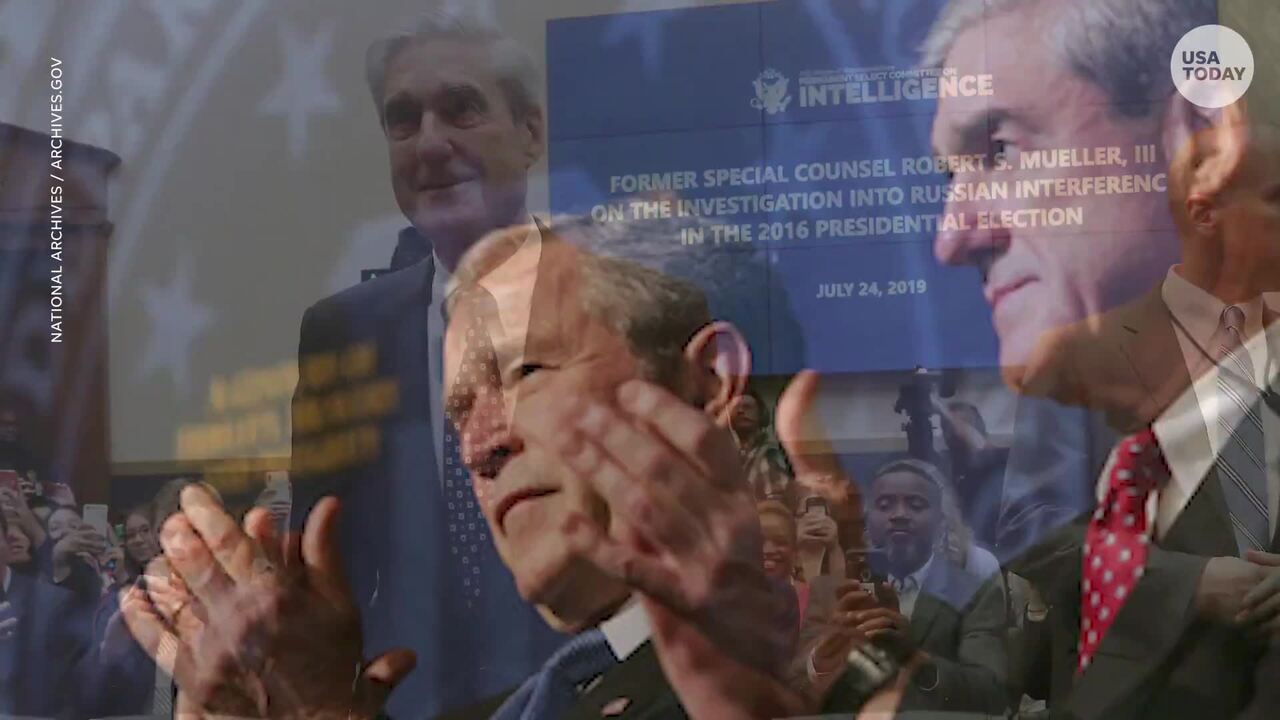
In dramatic but often halting testimony on July 24, 2019, Mueller refused to say that it did, and confirmed his view that a president could face charges after leaving office.
Mueller, consistent with his decades as a button-down lawman, gave many one-word answers. That frustrated Republican and Democratic lawmakers alike. But he rejected claims that his investigation was a "witch hunt" – or that it totally exonerated the president, as Trump and his Republican supporters claimed.

Critics were brutal, describing Mueller's testimony as "excruciatingly awkward," "confused," "struggling" and "a stammering, stuttering mess."
But one former federal prosecutor,Renato Mariotti, wrote that, "History will show that he had one big goal, and nailed it."
"Mueller's down-the-middle, leak-free handling of the high-stakes investigation was an object lesson in professionalism," Mariotti wrote in Politico.
Trump has insisted that Mueller's investigation into his first White House campaign and its connections with Moscow are a hoax. A Trump-appointed federal prosecutor in South Florida is now leading an investigation into it, andsubpoenaing Comey and othersas part of it.
This article originally appeared on USA TODAY:What to know about former FBI chief and Trump foe Robert Mueller
